
 Arabic

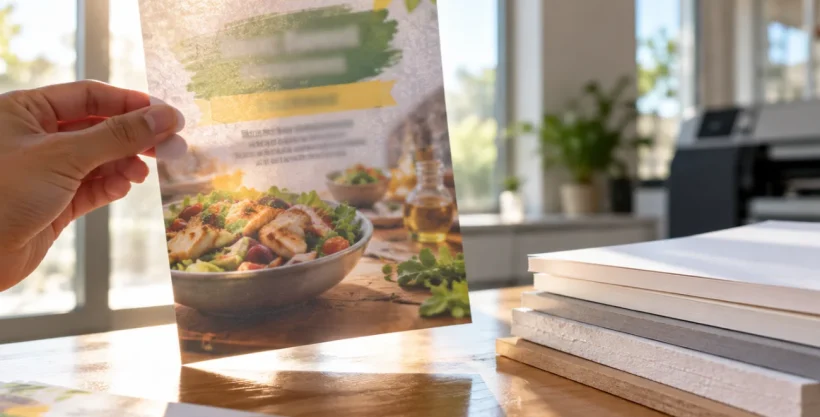
An A4 sheet at 80 gsm weighs roughly five grams. That is the feel of a flyer that folds in the first gust of wind, curls in a hot car, or lets the dark photo on the back show through the front. Picking the best paper for flyers starts with that small number, then pairs it with a finish that suits the artwork. This guide covers weight, matte vs gloss paper, and the file setup that keeps a good stock choice from going to waste. Treat it as general information, since your printer’s own stock list has the final say.
What Does GSM Mean and How Does It Set Flyer Paper Weight?
The GSM paper meaning is plain enough: grams per square metre. It is the mass of one square metre of the sheet, and ISO 536 sets out how paper and board get tested for it. A4 measures 210 by 297 mm, which is about 0.062 square metres, so an 80 gsm sheet lands near five grams.
Flyer paper weight sorts into rough bands, and printers draw the lines in slightly different places. Somewhere around 90 to 130 gsm feels like everyday office or newsletter paper. That suits a handout slipped into a shopping bag. From about 150 to 170 gsm, the sheet feels firmer, closer to a leaflet. Past 200 gsm, you are holding a thin card, which works for a flyer that doubles as a coupon or a table card.
Heavier stock costs more to buy and more to carry. A higher number is not an upgrade by default.
Matching the Best Paper for Flyers to the Job
Handling decides weight faster than any chart does.
A flyer pushed under doors or tucked beneath windscreen wipers gets read in seconds. Lighter stock is reasonable there, and the stack stays easy to carry. A flyer left on a counter, pinned to a notice board or dropped into a parcel is handled for weeks, so a thicker sheet resists creasing and feels deliberate in the hand.
Double-sided flyers raise a second question, which is opacity. If the back carries a dark photo, thin paper may let a ghost of it through to the front. Ask for a sample sheet, hold it up to a window, and judge it with your own eyes.
Matte vs Gloss Paper in Plain Terms
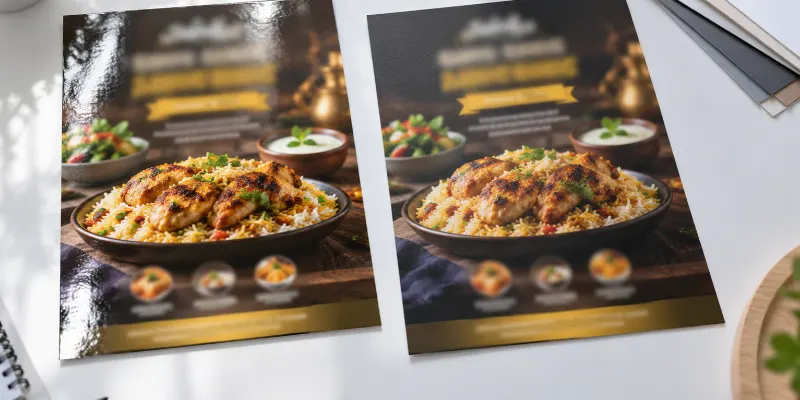
Finish changes how ink sits and how light bounces off it. Gloss coated paper has a high sheen and tends to give photos deeper colour contrast. Matte coated paper looks flat, reads calmly under bright shop lighting, and is usually kinder to fingerprints. Satin sits between the two. Printing United Alliance gives typical coated-paper gloss readings of 55 percent and above for gloss, 21 to 54 for dull, and 0 to 20 for matte.
Photo-led flyers, such as property listings or menu offers, often lean towards gloss. Text-led ones, such as event schedules or notices, tend to read better on matte, where pen ink is less likely to smudge. Gloss sheets can feel thinner than matte sheets of the same gsm, so judge weight and finish together.
Nobody can name one best paper for flyers in the abstract, since content, handling and budget pull in different directions. Embossing, debossing and hot foiling add texture or a metallic finish to paper, and they usually stay with higher-end pieces. Raise them with the printer before the artwork is final.
File Setup Before the Paper Matters
Digital printing is the usual route for flyers, brochures and business cards, since it handles fine detail and full colour without a long setup. Short runs and quick reprints become practical too.
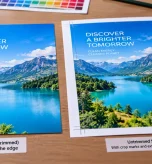
Paper choice only works if the file is ready for it. Sheets get cut after printing, and the blade never lands in exactly the same spot twice, so artwork needs to bleed. Many printers ask for about 3 mm on every side. An A4 flyer at 210 by 297 mm becomes 216 by 303 mm once bleed is added. Keep headlines and phone numbers about 3 to 5 mm inside the trim line, and use images at around 300 dpi so edges stay sharp. Printers set their own numbers, so ask before exporting the PDF.
Final Thoughts
Start from the job, then pick the weight, then the finish. A light matte sheet suits a text-heavy handout. A firmer gloss sheet suits a photo-led offer that people will keep. Ask your printer for two or three physical samples, and compare them in the light where the flyer will be read.
For reference, Al Fajer Advertising Gifts Trading LLC is a Sharjah-based printing and branding company that publishes guides on topics such as bleed and printing methods.
Which sheet would still look good after a week at the bottom of a bag?